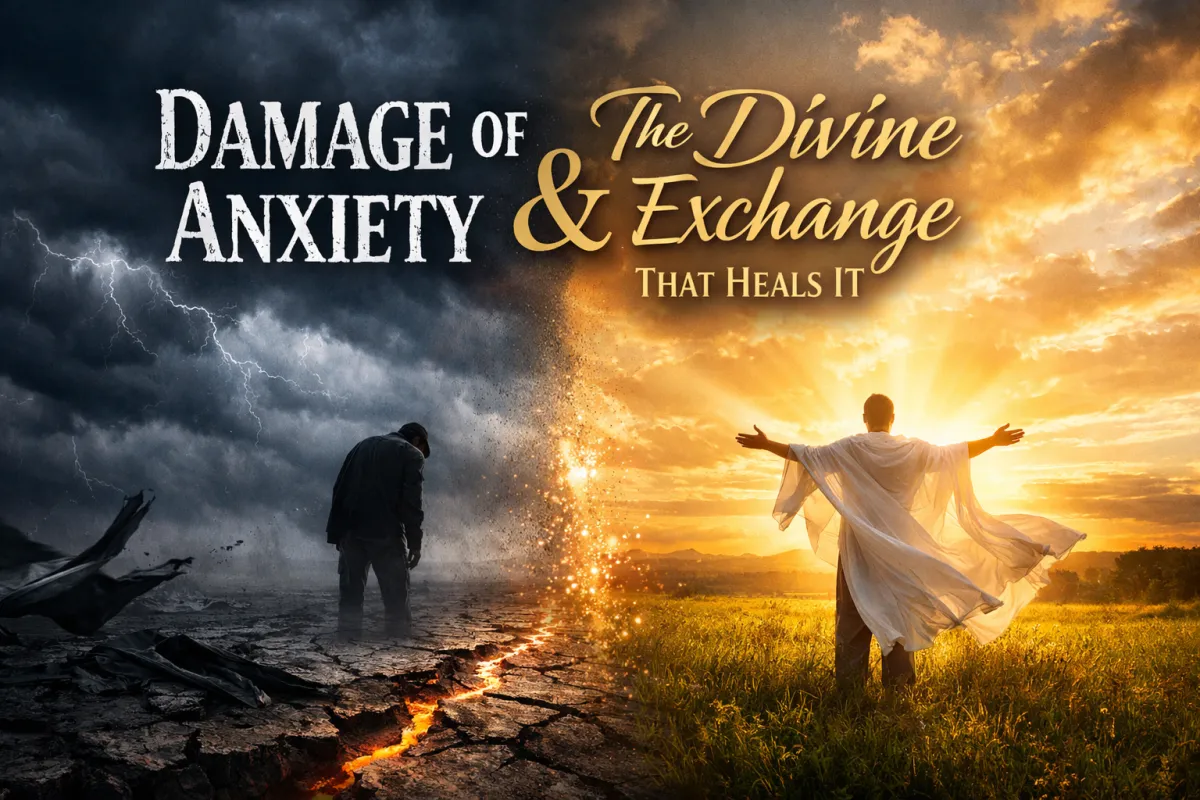
The Damage of Anxiety and the Divine Exchange That Heals It
There Is A River — Women’s Sober Living | San Antonio
Integrated Recovery — Mind, Body & Soul
A structured, supportive home for women building lasting recovery.
📞 830-642-1599 | 📝 Apply: thereisariver.com/application
Anxiety is so normalized in our age that we almost treat it as a personality trait.
“I’m just anxious.”
“That’s just how I am.”
“It’s a stressful season.”
Even "my anxiety"...
But when we slow down long enough to examine it, anxiety is not harmless background noise. It is corrosive. It is metabolically expensive. It is spiritually distorting. It is financially draining. And left unchecked, it becomes globally contagious.
Let’s zoom out first.
The Global Cost of Anxiety
Anxiety disorders are now among the most common mental health challenges worldwide. Entire industries thrive on managing stress symptoms. Lost productivity, healthcare expenditures, addiction cycles, burnout, relational breakdown, impulsive decision-making — these are not isolated personal issues. They scale.
An anxious population:
Consumes more.
Reacts more.
Polarizes more.
Hoards more.
Distrusts more.
Spends more on temporary relief.
Fear-driven economics fuel debt.
Fear-driven politics fuel division.
Fear-driven media fuels escalation.
Anxiety narrows vision. And when vision narrows collectively, societies fracture.
Now zoom in.
The Personal Toll
Anxiety is not merely a thought pattern. It is a full-body event.
Mentally:
Rumination loops.
Catastrophic thinking.
Impaired concentration.
Decision fatigue.
Physically:
Elevated cortisol.
Tightened musculature.
Compromised digestion.
Shallow breathing.
Suppressed immune function.
Sleep disruption.
Financially:
Reactive spending.
Avoidance of strategic planning.
Paralysis in opportunity.
Or conversely, reckless leaps to escape discomfort.
Anxiety shrinks possibility. It constricts creativity. It drains metabolic resources required to build, repair, imagine, and hope.
And yet — here is the strange thing.
Anxiety is almost always about something outside of present control.
It is preoccupation with:
What already happened.
What might happen.
What someone else thinks.
What could go wrong.
It is rarely about something happening right now that we have direct authority over.
Jesus addressed this with almost startling practicality:
“Which of you by worrying can add one cubit unto his stature?” (Matthew 6:27)
The Greek verb for “worry” is μεριμνάω (merimnaō) — to be divided, pulled apart, distracted in mind. It carries the image of internal fragmentation.
Anxiety does not enlarge us.
It does not strengthen us.
It does not lengthen our lives.
It divides us.
You cannot add an inch.
You cannot extend your lifespan.
You cannot secure tomorrow by rehearsing it in fear.
Anxiety offers the illusion of control while delivering fragmentation.
Scripture tells us repeatedly not to fear — so frequently that many note it appears in some form for every day of the year. The repetition is not poetic flourish. It reflects the human tendency to default toward fear.
The Bible does not deny danger.
It denies fear the throne.
Martha: Productive, But Fragmented
Consider Martha in Luke 10. She was not lazy. She was not immoral. She was serving.
Yet Jesus said, “Martha, Martha, you are anxious and troubled about many things.”
Again the word is memimnao, μεριμνάω — divided, distracted, pulled apart.
Her productivity was not the issue. Her fragmentation was.
She was doing good work from a disordered internal state.
Anxiety was stealing the joy of the very thing she was accomplishing.
How many modern Marthas are building, serving, producing — while internally unraveling?
Jesus did not rebuke her service. He addressed her anxiety.
Because anxiety ruins the day long before the day ruins us.
Anxiety’s Counterfeit Comfort: The Road to Addiction
Anxiety is metabolically exhausting.
The body does not like sustained cortisol. The mind does not like endless threat simulation. The nervous system does not tolerate chronic fragmentation forever.
So it looks for relief.
Relief is not wrong. Relief is biological.
But when relief is sought outside of regulation, it often becomes addiction.
Substances.
Scrolling.
Spending.
Pornography.
Control.
Work.
Food.
Approval.
Even ministry.
Addiction is rarely the primary issue. It is often an attempt to medicate anxiety.
A self-administered anesthetic for internal division.
Addictive behaviors narrow consciousness just like anxiety does. They compress awareness into one focal point. They silence the spiral for a moment.
But they do not resolve it. They deepen it.
Because what is medicated but not transformed returns stronger.
This is why recovery is not merely about abstaining. It is about replacement.
Isaiah does not say try harder. He says exchange.
Paul does not say white-knuckle it. He says present, give thanks, receive peace.
In recovery language we speak of triggers and coping strategies. Scripture speaks of casting and clothing.
Both acknowledge the same truth:
The nervous system must be retrained.
Isaiah’s Exchange: Trade, Don’t Tame
Isaiah 61:3 offers something radical:
To give unto them beauty for ashes,
the oil of joy for mourning,
the garment of praise for the spirit of heaviness.
The Hebrew for “heaviness” (ruach keheh) carries the sense of dimness, faintness, a spirit weighed down.
The remedy is not analysis. It is clothing.
A garment of praise.
Put it on.
This is tactical. Intentional. Embodied.
You do not negotiate with heaviness.
You replace it.
Paul’s Formula: The Replacement Strategy
Philippians 4:6–7 gives us the mechanics:
“Be anxious for nothing, but in everything by prayer and supplication, with thanksgiving, let your requests be made known unto God.”
Paul assumes we have needs. He does not deny them.
But he instructs us to change posture.
Recognize the anxiety.
Present the request.
Add thanksgiving.
The word for guard (phroureō) is military — a garrison, an armed sentinel.
Gratitude is not sentimental.
It is neurological.
It is spiritual armor.
The Science of Replacement
Modern neuroscience increasingly confirms what Scripture prescribed centuries ago.
Focused gratitude and active anxiety use overlapping neural pathways. When one is deliberately strengthened, the other weakens.
Gratitude:
Activates regulatory regions of the prefrontal cortex.
Reduces amygdala overactivation.
Lowers cortisol.
Improves vagal tone.
Broadens cognitive flexibility.
Anxiety narrows.
Gratitude widens.
Anxiety spirals.
Gratitude stabilizes.
Anxiety constricts breathing.
Gratitude deepens it.
When gratitude is intentionally practiced, autonomic balance shifts toward parasympathetic dominance. Heart rate slows. Muscles release. Digestion resumes.
The nervous system resets.
Instead of trying to resolve every feared scenario, you replace the internal state.
This is exactly what Isaiah described.
This is exactly what Paul prescribed.
Not suppression.
Replacement.
Fear vs. Present Authority
Most anxiety is future-based simulation.
Authority exists only in the present.
You cannot act in tomorrow.
You can act now.
You cannot undo yesterday.
You can respond today.
“Sufficient unto the day is the evil thereof.”
Anxiety operates outside jurisdiction.
Gratitude anchors you back into jurisdiction.
What is true right now?
What has been provided?
What strength do I have in this moment?
As soon as you begin to name those things, fragmentation begins to reassemble.
A Conscious, Physiological Tactic
This is not mere spiritual poetry.
This is deliberate training.
When anxiety rises:
Name it.
Present the need.
Add thanksgiving.
Speak praise aloud if necessary.
This is not pretending.
It is replacing.
Neural retraining.
Nervous system recalibration.
Spiritual alignment.
Perhaps anxiety was never meant to be solved by analysis.
Perhaps it was meant to be displaced.
Beauty for ashes.
Joy for mourning.
Praise for heaviness.
You cannot add an inch by worrying.
But you can widen your internal world by worship.
And in that widening, peace stands guard.
If you or someone you love is ready for steady ground and structured recovery in San Antonio, There Is A River is here.
There Is A River — Women’s Sober Living | San Antonio
Integrated Recovery — Mind, Body & Soul
📞 830-642-1599 | 📝 Apply: thereisariver.com/application
