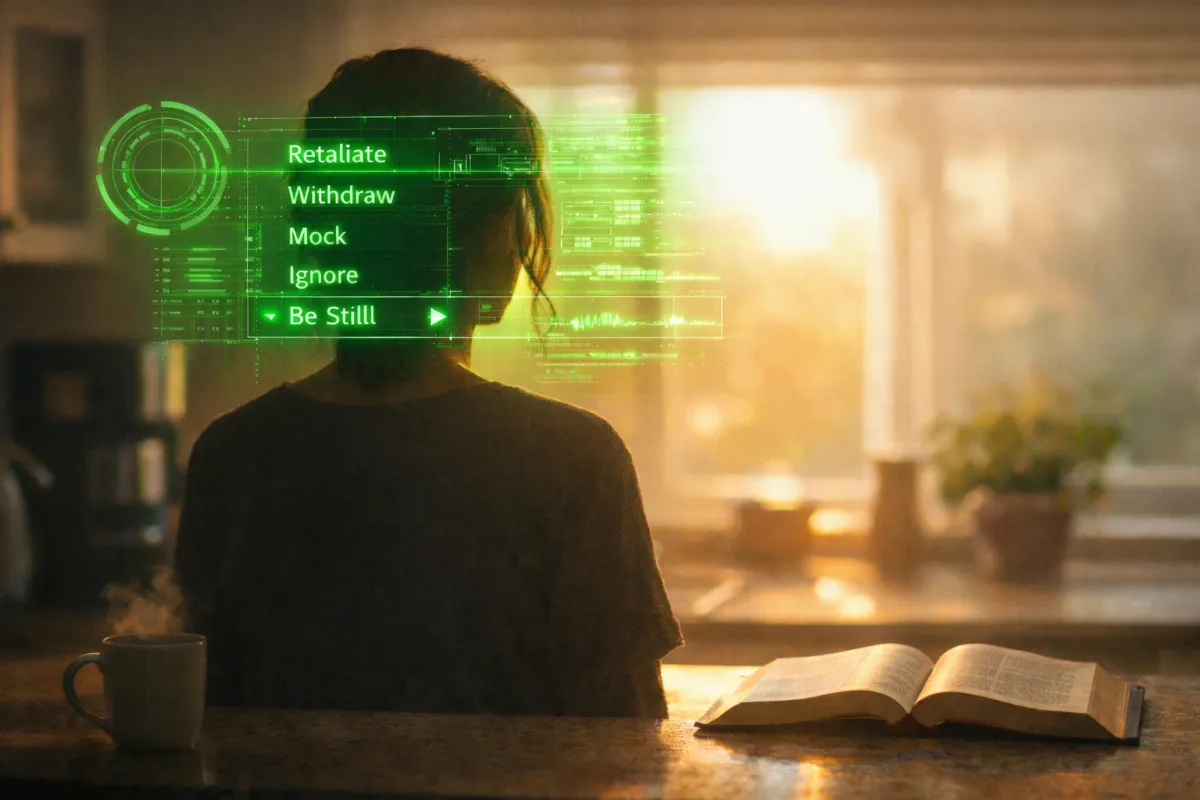
The Cyborg in the Kitchen
There Is A River
Integrated Recovery — Mind, Body & Soul
San Antonio Women’s Home
Apply here: https://thereisariver.com/application
The Cyborg in the Kitchen
Biblical Self-Governance and the Sacred Space Between Stimulus and Response
There’s a scene in The Terminator where the cyborg, a robot covered in a human shell, is staying in a cheap rented room. The landlord bangs on the door, irritated, shouting something crude about a bad smell.
We see something the landlord cannot see.
The cyborg’s internal screen becomes visible to the audience — a digital overlay, an HUD, a “heads-up display.” The insult is processed. A list of possible verbal responses scrolls across the internal interface. Several options appear, each progressively more aggressive.
One response becomes highlighted.
The machine selects it.
The cyborg repeats the chosen phrase out loud — harsh, blunt, confrontational.
The landlord shrugs and walks away.
Scene over.
What makes the moment powerful is not the insult.
It’s the menu.
The cyborg does not feel offended.
It does not deliberate morally.
It does not reflect.
It scans.
It calculates.
It selects.
It executes.
And that’s it.
("Possible response" - The Terminator (Cameron, 1984)
The Menu Most of Us Don’t See
This morning, in my own kitchen, I saw my own internal cyborg.
Not metaphorically.
Visibly.
The insult wasn’t shouted through a door. It came in the form of silence. A turned back. A refusal of eye contact. A relational freeze.
A housemate had decided the best solution to her own internal mayhem was to give me the silent treatment — and it stung.
I could feel my body responding before I had a single conscious thought about it. A tightening in my chest. Heat rising. A flash of something that felt ancient. Primeval even. The kind of alarm that might once have meant exile from the tribe. Expulsion. Vulnerability. Danger.
Surely there were also old fault lines of my own lighting up — old patterns, old wounds, old reflexes.
But this wasn’t theoretical.
It was physical.
My nervous system surged.
And along with the surge came a neat little parade of possible zingers — sharp, clever, perfectly calibrated retorts that could restore the balance of power in an instant. I could feel them forming on my tongue, lining up for release.
And suddenly I could see it — my own internal HUD, heads-up display.
Not metaphorically.
Visibly.
It was as if some transparent screen had overlaid my perception of the moment. Data streaming. Threat detected! Social rejection registered. STATUS COMPROMISED!
And then the options began to scroll.
Retaliate.
Mock.
Punish.
Be icy.
Be superior.
Each one felt momentarily satisfying. Each one promised relief. Each one would have restored equilibrium in a different way.
For a split second, I understood something unsettling and liberating at the same time:
Most of the time, we don’t realize there is a menu.
We think the highlighted response is us.
But this time, I wasn’t fused with the highlight.
I was watching it.
And that changed everything.
The Robot in the Cloud
Maybe because I’ve been scrutinizing my nervous system reactions very deliberately in recent days.
Maybe because with my 3-year-old grandson we sometimes query ChatGPT for recipes and interesting questions, and he recently asked his mother, “Do YOU have a robot friend who lives in the cloud who could figure that out?”
Maybe because this morning it occurred to me that we ALL have a kind of robot friend who lives inside of us — helping to sort information, protect, and defend —
I felt like I was watching the whole thing in slow motion.
The responses were lining up.
I could feel them forming — rising like a sword about to issue forth from my mouth.
Sharp. Effective. Instantly satisfying.
And yet, in that slowed-down awareness, I could see something else.
None of them fit.
None of them fit with my very real understanding that my housemate was facing very real problems.
None of them fit with the truth that her silence was not actually about me.
None of them fit with my very real commitment to — as Ephesians 4:32 says — “do not let any unwholesome words come out of your mouth.”
It occurred to me, in that suspended moment, that those responses had been conjured up by my own defensive system. They were designed to produce an instant result — a restoration of power, a rebalancing of dignity, a discharge of tension.
But they were also designed to produce something I did not truly want.
Escalation.
Distance.
Damage.
The robot inside me had done its job beautifully. It had scanned the threat. It had generated options. It had prepared for battle.
But I realized something critical:
The robot is not the ruler.
It is a servant.
And in that moment, even though it stung, I decided to say nothing.
Suppression vs. Governance
Now this is not the first time I bit my tongue and avoided a harsh word.
But it was a different kind of first.
Typically, when I get riled up over something — not very often — and I have some choice words that I swallow, I get spiritual indigestion for hours, even days. The words may not come out of my mouth, but they circle internally, demanding airtime.
I often need to call someone who gets me and tell them what happened (my favorite).
Or journal about it. ALL CAPS.
Or expel the tension in physical exertion of some sort.
Or doomscroll.
Or sleep it off.
The energy has to go somewhere.
Suppression isn’t the same thing as peace.
But this time was different.
This time, I felt this curious layer of separation between myself as driver and the excitable cyborg I was riding.
The cyborg was fully operational.
Sensors online.
Threat assessment complete.
Verbal weapons polished and ready.
But I wasn’t inside it.
I was aware of it.
There was no white-knuckling.
No jaw clenching.
No internal wrestling match.
Just… awareness.
Like sitting in the driver’s seat of a powerful machine and realizing, with calm clarity, “Ah. You want to accelerate right now.”
And choosing not to press the gas.
The activation was real.
The sting was real.
The sword was real.
But the fusion was gone.
Instead of being the sword, I was the one watching it form.
Instead of being the reaction, I was the one deciding whether it served the larger mission.
And something surprising happened.
Without a fight… it diffused.
Not instantly gone.
But no longer in control.
Like a radio sounding in the background.
It was like telling my daughter’s hypervigilant Belgian Malinois that no, the Amazon delivery guy is NOT a mortal threat.
The dog isn’t bad. It’s loyal, fast, exquisitely alert. It sees movement and assumes danger. Muscles engage. Bark loads.
Its job is protection.
But someone has to say, calmly, “Stand down.”
That’s what it felt like inside me.
My internal alarm system had spotted relational rejection and classified it as threat. All systems lit up!
And instead of suppressing it or unleashing it, I simply recognized it:
“I see why you think this is danger. But this isn’t a mortal threat.”
The dog didn’t vanish.
It settled.
Because the driver was steady.
The Gap That Makes Us Human
There are volumes and philosophies about what free will is and isn’t, and I won’t attempt to solve that debate here. But one thing free will clearly is — and what sets us apart from the animals — is that we actually have (even if rarely exercised) a moment of space between stimulus and response.
There is a pause.
A sliver of time.
A decision point.
And in that space, we can choose differently.
This is why cognitive behavioral practices work. This is why mindfulness has traction. These methodologies train us to notice the gap, extend it, widen the menu.
They teach us to see the HUD.
But my thesis is this:
Better than any behavioral methodology, the Bible — as the Owner’s Manual — gives us the most comprehensive strategy for managing ourselves.
Scripture assumes the gap.
David speaks to his own soul:
“Why are you downcast, O my soul? and why are you disquieted within me? Have hope in God!” (Psalm 42:5)
That is a man observing his internal state and redirecting it.
Psalm 4:4 instructs:
“Stand in awe, and do not sin. Meditate within your heart on your bed, and be still.”
Awareness before execution.
Psalm 131:2 goes even further:
“Surely I have calmed and quieted my soul, like a weaned child with his mother…”
That is not suppression.
That is self-soothing under governance.
Proverbs warns us:
“There is a way that seems right to a man, but its end is the way of death.”
(Proverbs 14:12)
The autonomic system often feels right because it is fast, rehearsed, and emotionally charged.
But Scripture calls us higher:
“For as many as are led by the Spirit of God, these are sons of God.” (Romans 8:14)
Not driven by reflex.
Led.
And of course, Jesus Himself assumes the gap.
He doesn’t deny the surge of insult, anger, or injustice.
He addresses what we do in that sliver of space.
“But I tell you not to resist an evil person. But whoever slaps you on your right cheek, turn the other to him also.” (Matthew 5:39, NKJV)
That is not passivity.
That is governance.
The cheek is struck. The nervous system activates. The impulse to retaliate surges.
And yet — another option is chosen.
He continues:
“And whoever compels you to go one mile, go with him two.” (Matthew 5:41, NKJV)
The first mile may be forced.
The second mile is chosen.
That second mile exists in the gap.
And then the piercing clarity:
“First remove the plank from your own eye, and then you will see clearly to remove the speck from your brother’s eye.” (Matthew 7:5, NKJV)
Before addressing the external offense, inspect the internal distortion.
Before executing the highlighted response, examine the lens.
Jesus does not pretend insult doesn’t sting.
He trains the driver.
He widens the menu.
He reorders instinct.
Scripture repeatedly assumes the gap: “Be angry, and do not sin” (Ephesians 4:26, NKJV). “Let every man be swift to hear, slow to speak, slow to wrath” (James 1:19, NKJV). “Do not hasten in your spirit to be angry” (Ecclesiastes 7:9, NKJV). The reflex is acknowledged — but governance is commanded.
And Paul says plainly:
“I discipline my body and bring it into subjection.” (1 Corinthians 9:27)
Which assumes there is something powerful enough inside of us that it must be trained — not denied, not despised — trained.
The Bible does not pretend the cyborg isn’t there.
It teaches us how to drive it.
But here is where Scripture goes beyond behavior modification.
CBT can help us pause. Mindfulness can help us observe. But the Bible does something deeper: it realigns the cyborg with its truer mission.
We are not merely suppressing impulses. We are redirecting them toward purpose.
When the Spirit leads, the nervous system is not just restrained — it is reoriented. The defensive system that once served pride or self-protection is retrained to serve love, truth, courage, and eternal perspective.
The power to choose differently does not come from white-knuckled discipline alone.
It comes from remembering who we are, whose we are, and what we are ultimately living for.
When mission expands, reaction shrinks.
That’s the theological difference.
Secular frameworks widen the gap.
Scripture fills the gap with meaning.
And meaning gives greater strength.
Managing the Gap in Recovery
In sober living, this gap is everything.
Addiction is stimulus-response on autopilot.
Trigger → Craving → Action.
Shame → Numbing → Escalation.
Relational rupture → Fight or flight → Burn it down.
Integrated Recovery — Mind, Body & Soul — is about restoring the gap.
It is about teaching the driver to recognize the internal HUD.
To say to the hypervigilant dog, “Stand down.”
To say to the cyborg, “Thank you for the options. We are not selecting that one.”
Recovery is not about eliminating emotion.
It is about governing it.
Not suppressing anger.
But being angry and not sinning.
Not denying fear.
But calming the soul like a weaned child.
Not pretending the autonomic system doesn’t exist.
But refusing to let it rule.
And that morning in the kitchen, when the sting was real and the menu was scrolling, I realized something I had never seen so clearly before:
We are not the highlight.
We are the one who chooses.
But here is the deeper truth.
The gap is not sustained by willpower alone.
The Bible does not call us to self-mastery in isolation. It calls us to Spirit-empowered governance.
“For it is God who works in you both to will and to do, for His good pleasure.” (Philippians 2:13, NKJV)
We are not managing the cyborg by sheer will or force of personality.
We are being strengthened from within.
When Scripture says we are to be “led by the Spirit of God” (Romans 8:14), it is not describing moral strain. It is describing alignment.
The defensive system that once operated in fear can be repurposed in love.
The reflex that once protected ego can be retrained to serve courage.
The power to choose differently comes not merely from trying harder, but from living connected to a greater Source.
Even in recovery language, we speak of surrendering to a Higher Power.
The gospel simply names Him.
And when the Spirit fills the gap, discipline becomes less about clenching and more about cooperation.
Not suppression.
Transformation.
This reflection became a song — actually two songs! Press play below for the first version
Second version:
If you or someone you love needs a structured, compassionate environment to rebuild life with intentionality and spiritual grounding:
There Is A River — Integrated Recovery: Mind, Body & Soul
San Antonio, Texas
Apply here: https://thereisariver.com/application
Call: 830-642-1599
